

For most women, yes, irregular periods after delivery are completely normal. Your body has spent the better part of a year running on pregnancy hormones, and asking it to reset overnight just isn’t realistic. Cycles can skip, shorten, lengthen or show up early for months before things settle into a rhythm. If you’re breastfeeding, that reset usually takes even longer, since prolactin keeps ovulation switched off for a while. Bodies vary a lot here, and that variability itself is expected, not a warning sign on its own.
According to Dr. Tanuja Uchil, Obstetrician and Gynecologist in Mumbai, “Patients often panic the moment a cycle skips a month or shows up twice in five weeks. In the first six months postpartum, that’s usually just the body finding its footing again. What actually needs a closer look is bleeding that won’t stop, or periods that never show up at all past a year.”
Still no regular cycle six months after delivery?
What Causes Irregular Periods After Childbirth?
A few things drive this, and they rarely act alone.
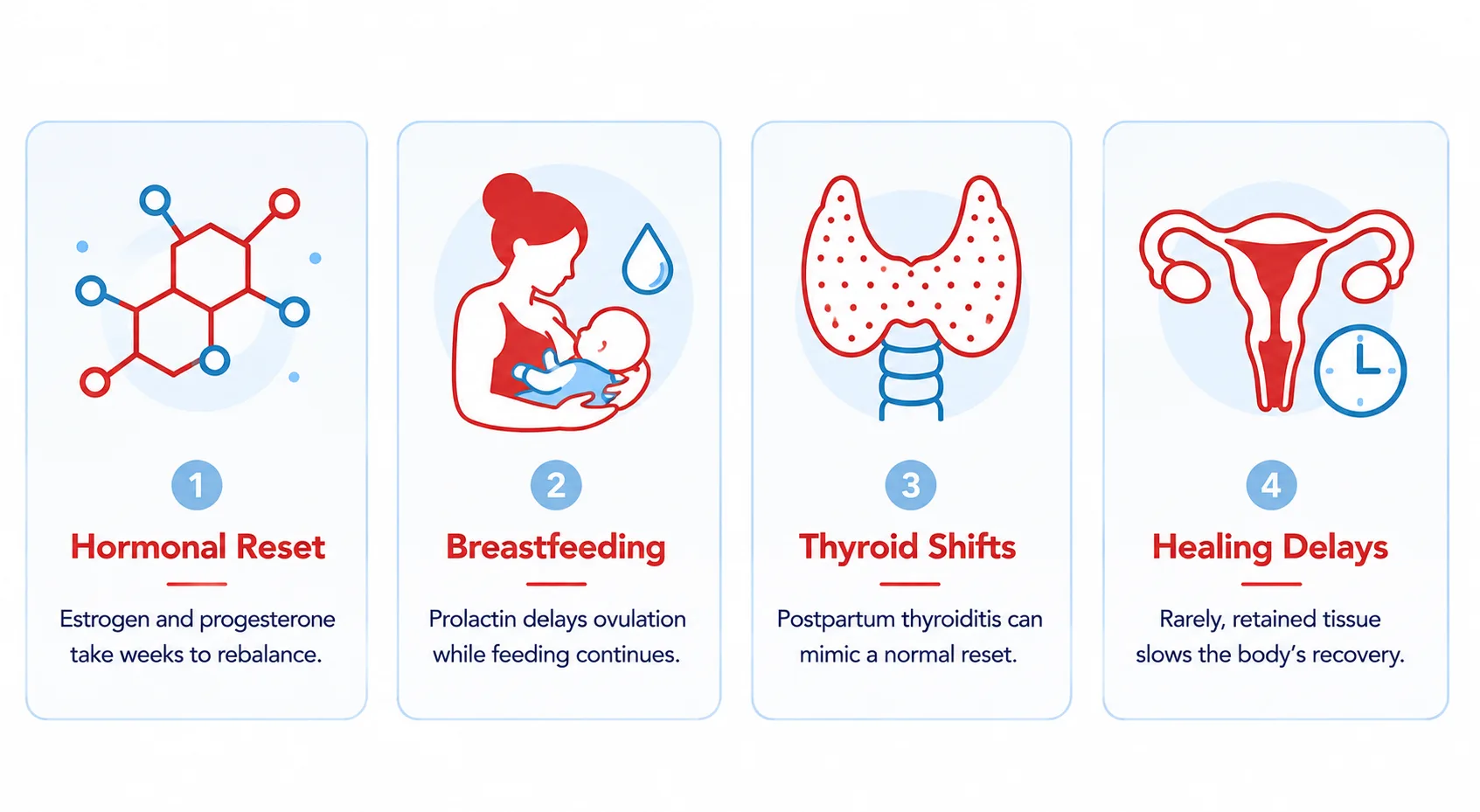
Each of these plays a different role in why cycles take time to settle after childbirth. Hormones drop fast, breastfeeding pushes things back further, thyroid changes are easy to miss, and healing issues are rare but real. None of them point to something wrong on their own. Most sort themselves out within a few months. But if you’re unsure which one applies to you, our gynecology specialists can check it in a single visit.
When Should Irregular Periods After Delivery Worry You?
Some signs are worth flagging early rather than waiting out.
No period past 12 months: If you’re not breastfeeding and haven’t had a period a year after delivery, that’s outside the normal range.
Soaking a pad hourly: Heavy bleeding that doesn’t ease off, especially with clots larger than a lemon, needs same day attention.
Cycles under 21 days apart: Once periods “return,” a cycle repeatedly shorter than three weeks deserves a second opinion.
Pain that keeps building: Cramping that worsens cycle over cycle rather than easing isn’t something to just push through.
Several of these overlap with what we cover in our postpartum recovery guide, so that’s worth a read too.
Why Choose Dr. Tanuja Uchil for Postpartum Period Concerns?
Dr. Tanuja Uchil has practised obstetrics and gynecology for over 25 years, with an MD from Seth GS Medical College and KEM Hospital and further fetal medicine training from Kiel, Germany. That mix of maternity and gynecology experience matters here, since postpartum bleeding patterns often sit right at the overlap of both fields. Her approach rules out the serious causes first, then gives the body room to settle on its own timeline. She works alongside OMA’s wider maternity and gynecology team, so nothing falls through the gap between departments. For a concern this specific to the months after delivery, that combined view is what actually helps.
Postpartum period irregularities can look alarming even when they’re completely benign, and telling the two apart takes more than a quick search online. Dr. Uchil’s approach factors in your bleeding pattern, feeding status and delivery history rather than applying one generic timeline. Patients usually leave with a clear answer on whether what they’re seeing is expected or needs a next step.
Call +91 72089 73301 to book your consultation.
FAQ
How long can periods stay irregular after delivery?
Anywhere from six months to a year, longer if breastfeeding continues.
Does breastfeeding delay periods returning?
Yes, prolactin suppresses ovulation, often delaying periods for breastfeeding mothers.
Can I get pregnant before my period returns?
Yes, ovulation can occur before the first postpartum period arrives.
When is heavy postpartum bleeding an emergency?
Soaking a pad hourly or passing large clots needs immediate medical attention.
Disclaimer: This blog is for educational purposes only and does not replace professional medical advice; please consult a qualified doctor for concerns specific to you.